Click or tap image to read
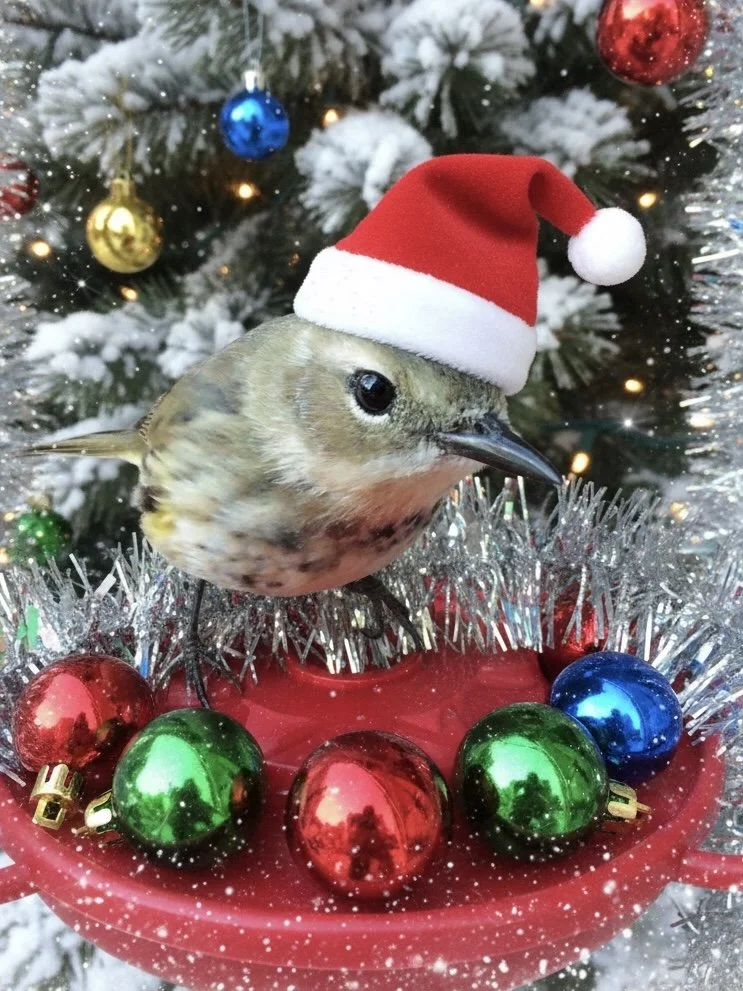
Yellow-rumped Warbler, ready for the holidays!
As we speed into the holiday season I am busy thinking about all the people I want to give gifts to, and trying to figure out some ways that I can make people happy and also support the things that I care about at the same time. I have quite a few friends who give donations in the name of loved ones as a gift. This is a great way to give back but it is not the only way! I have put together a little list sharing some ways that I am able to give to causes that I care about and gift items that will make people happy all at the same time.
This first one, Conscious Step, is a company that partners with a variety of great causes that you can choose to support. They sell primarily really cute themed socks, but also some other clothing options. Personally I shop in the section that helps conserve our rainforests. These make great stocking stuffers!
This next one is a shoe company P448 which's mission statement shares that they are a forward-thinking brand that is focused on making products that contribute to a cleaner, greener, and more inclusive world. These are great gifts for fashion focused loved ones. They have a line that is called their Invasive Species line which includes shoes that make use of problematic species that are being culled, for example, Burmese Pythons from the Everglades or Lionfish which threaten our reefs.
This next one, Giftiply is a gift wrapping company. You can purchase your wrapping paper or cards from them and 33% of your purchase will go to the cause that you choose your collection from. I personally like the Wildlife Conservation section here.
https://www.giftiply.com/category/wildlife-conservation-network
I am also a big fan of t-shirts that support causes that I care about. Bonfire is a fantastic site for finding shirts that support causes you care about. Bonfire is a platform that allows organizations or individuals to sell shirts to their followers with a part of the cost going to Bonfire to cover the cost of the product and the rest going to a cause that has created a fundraising effort. Here is an example of one that caught my eye, however, there are many, many options.
Next we have Bird Collective, a company that provides a variety of bird inspired items that contribute to specific bird conservation groups, for example, they have a collection that gives specifically to grassland birds or International Crane Foundation or Hawkwatch International, among others. Bird Collective has a nice selection of bird inspired clothing, as well as, books, games, puzzles, and other birdy gifts.
https://www.birdcollective.com/
Shade grown coffee or chocolate is a fantastic way to give something someone will really enjoy that really does help conserve the migratory birds we love. The Smithsonian Zoo's Migratory Bird Center has created standards and certifications for farmers who grow coffee and chocolate. These standards help promote biodiversity, provide habitat and sustainability on these farms with shade grown coffee and chocolate, which happens to some of the best tasting coffee and chocolate you will ever get your hands on.
https://nationalzoo.si.edu/migratory-birds/buy-bird-friendly-coffee-online
Any time you can promote not using plastics in this one-use, throw away society you are doing something that improves the world. An easy plastic to leave out of your life is shampoo and conditioner bottles. There are quite a few businesses that make shampoo and conditioner bars. This one came highly recommended to me and that recommendation proved to be a good one. The shampoo bars are a bit of an adjustment particularly for someone like myself that has long hair but they leave my hair feeling wonderfully silky clean and smelling great!
Another company I frequently purchase gifts from is 4Oceans, a company that pulls plastics from the oceans. They have a variety of products that are made from the recycled plastics. Each of their attractive bracelets sponsors pulling one pound of trash out of the ocean and are themed towards supporting a specific animal that lives in or on our oceans.
This little list is by no means complete. I just want to encourage everyone to think outside the box and look for some gifts that give twice!
Happy Holidays!

Juli deGrummond at the Sapsucker Woods Wildlife Sanctuary in New York State.
Let there be a convocation of cardinals
In the backpacks and tents under our bed.
Let them fan the small campfire of our sleep.
Let Carolina wrens nest in the empty
guitar cases in our guest room closet.
Let them teach all hollow bodies to sing.
Let there be brown thrashers in our kitchen
stirring tales of plenty into stone soup.
Let there be grackles rising from the backs
of foxes in fields of clover. Let there be
yellow warblers in the subway tunnels
where dark and light chase each other from window
to rail to opening door. Let briefcases
turn inside out and become vesper sparrows.
Let there be finches gathering in the mouths
of presidents and the veins of generals.
Let them chirp in the ears of our enemies.
Let there be barred owls in my granddaughter’s
first breath and in my last. Let them hunt
as dusk consumes light and blackbirds usher
us into the realms of the dead. Let chickadees
drop seeds of next year’s crops into the furrows
of our famine. Let the birds, let the multitudes,
beat their wings to the national anthem
of each river and every star.
Let there be scarlet tanagers nesting
in my hair, hatching the eggs of my dreams.
Laura Newton
An earlier version of this poem was published in Redheaded Stepchild
Photo Credit: Male Summer Tanager, by Kathleen Carr
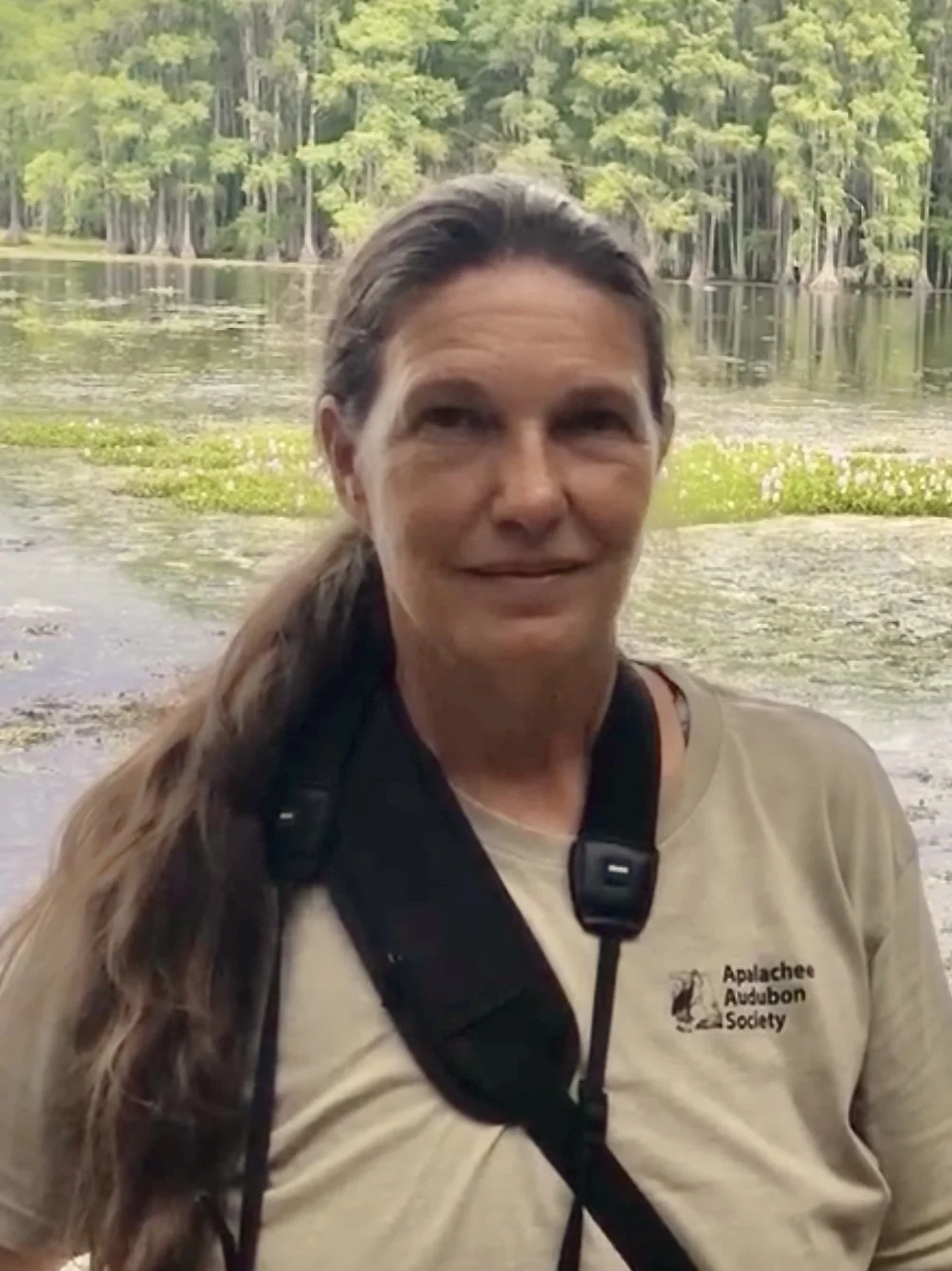
Juli deGrummond at Lake Munson
As you may recall, at the time of my last writing the first nest, which contained three baby snail kites had just fledged and the second nest contained three fuzzy babies. The first nest all three babies were banded and two of them were fitted with tracking devices that would allow their movements to be documented. Shortly after fledging I received a message that one of the fledgling's tracking device was no longer responding. The biologist indicated that in all likelihood this young bird had not made it but there was a slim chance that it's tracking device had quit working. Of course, I was desperate to see all three fledglings and know that this was incorrect.
During my time observing the fledglings, almost all of the time, two of the banded fledglings were seen together. They would perch on the same perch, sitting side by side eating snails together, flying high in the sky or simply around the lake together. I saw them on the close side of the lake multiple times and heard them "talking" to each other with their juvenile calls. I never could read their bands but one of the times when they were on the close side of the lake, I could have sworn that both birds had the tracking device on their backs. Finally, on August 16th I saw one of the banded fledglings by itself. It was close enough that I could see the band through my scope and get pictures that were legible! Banded Baby A06 was alive and well! This was, in fact, the missing offspring! I contacted FWC and let them know and they informed me that the tracking device had, in fact, picked back up and begun working again. They commented that it was odd how similar their flight paths were for the two birds with tracking units, but it made perfect sense to me since the two I most frequently saw hung around together. The day I saw A06 and got his number, he then went and perched with a younger sibling from nest number two. They definitely seemed to be purposely associating with one another. The two of them flew out and hunted snails and then each returned to the snag they were perching in together and that is where they were when I left that day.
Unfortunately, the second nest of babies never did get banded so we will soon lose track of them and not have their complete story at any time in the future, but I can say with certainty that three babies did fledge from that nest and two definitely were successful with learning how to hunt for snails and feed themselves.
But Wait—There’s More!
During the time that they were getting ready to fledge the mother worked hard to keep them fed and to defend the territory from any perceived threats. The father moved over to the far West side of the lake where he appeared to be overseeing another nest! When FWC came out to check it out, they indicated that there was definitely a nest and it appeared active. There was a male and a female Snail Kite present. They were unfortunately about a day or maybe two too late on banding the second nest. When they came out they saw that there were two freshly fledged young birds and that the mother was very actively guarding them.
Now, going back to the very beginning of these birds’ Tallahassee story, you may recall that there was a male and a female, and that the female that I first found was not the parent of the first two nests. This extra female was for most of this time the most viewable of the Snail Kites as she hung out on the close side of the lake, often hunting in the water hyacinths right in front of the little viewing dock. In the beginning of July she disappeared for about a week, and then made a few appearances again. After that I did not see her until yesterday (August 24th) at which time I viewed her through a scope sitting on the outside of the nest tree on the far West side of the lake. The male has been busy the past few days coming and going from that tree and I feel pretty sure that the two are feeding a new batch of babies.
On top of this exciting news, the mother bird from the previous two nests appears to be spending time in another nest, and I saw the male bird come to that nest and spend time there with her. It is possible that there are in fact two male birds but during the time he was at the mother bird's new nest tree, there was no male present at the other nest tree on the West side of the lake. Just when I think this story is starting to wrap up it takes another exciting turn! I can't wait to see what happens next!
See more photos—and bird species—in the following eBird Checklists that Juli submitted from Lake Munson.
Juli deGrummond at Lake Munson
I am always happy when I find a conservation story that helps me feel hopeful about our natural world's future. Here in Tallahassee, we have the beginning of what, I hope, will become an ongoing and uplifting story.
This story started on April 20th, 2025 with a trip to Gil Waters Preserve at Lake Munson, a Leon County park and a favorite birding spot of mine. Over the past few years, I have found many birds at this location, including quite a few rare or unusual birds, for example, a single male Snail Kite in 2024. As non-native, invasive Apple Snails at this location have thrived and covered the lower trunks of the beautiful cypress trees with their pink globs of eggs the local population of another snail specialist with its own past conservation concerns, the Limpkin, became a frequently heard and encountered inhabitant here. In fact, this location has become by far the best spot in our area for viewing Limpkins!
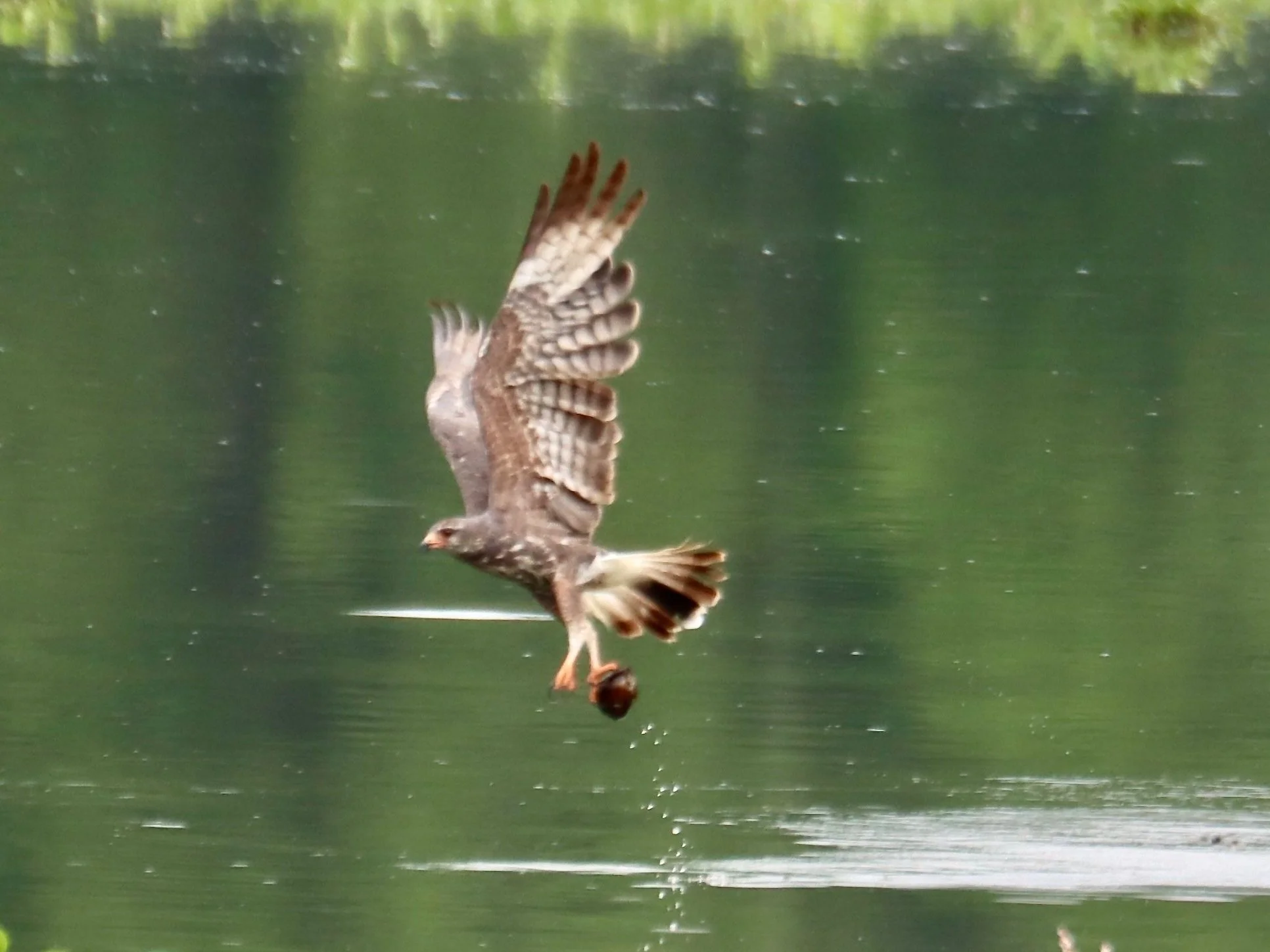
Snail Kite carrying its meal of Apple Snail.
On that fateful day, I found both a male and a female Snail Kite perched near each other. This immediately gave me hope that they could be a pair, potentially a breeding pair. Like most people, I have obligations in my life other than staring endlessly at Snail Kites but I began taking every free moment that I had to go to Lake Munson.
The Mating Tree: That month I was leading a field trip for the Orange County Audubon Society. We spent most of our time in neighboring Franklin County and Wakulla County but on April 25th as we made our way to the Tall Timbers Research Station, we made a stop at Lake Munson. As eight people and I watched with scopes and cameras, we witnessed, photographed, and even videoed the Snail Kites mating! Witnessing this event filled the entire group with excitement and joy. We gleefully named the tree in which this happened in "The Mating Tree". While spending this special time with the Snail Kites and my exuberant group of bird lovers, I also learned something new—the call of a Snail Kite.
I had seen Snail Kites both in Belize and in other parts of Florida. I always found them exotic and fantastic and I can vaguely remember listening to their call on Merlin but it did not strike me the same way it did when I heard it live. In fact, that past listening experience did not make an impact on me at all other than thinking it was not what I would have expected. While my cohorts from Orange County Audubon and I made our way around the edges of the lake I heard what I thought was a goat, and that charming goat-like call turned out to be the female Snail Kite! This discovery got my blood pumping and resulted in me dreaming about making recordings of it in the future.
The Nesting Tree: Two days later I took my mom to Lake Munson to share the Snail Kites with her. As we sat with the scope trained on The Mating Tree, we observed the male Snail Kite building a nest in the exact spot that the birds were seen mating. And thus, The Mating Tree became The Nesting Tree. After that, day after day, anytime I was not at work I was watching the Snail Kites.
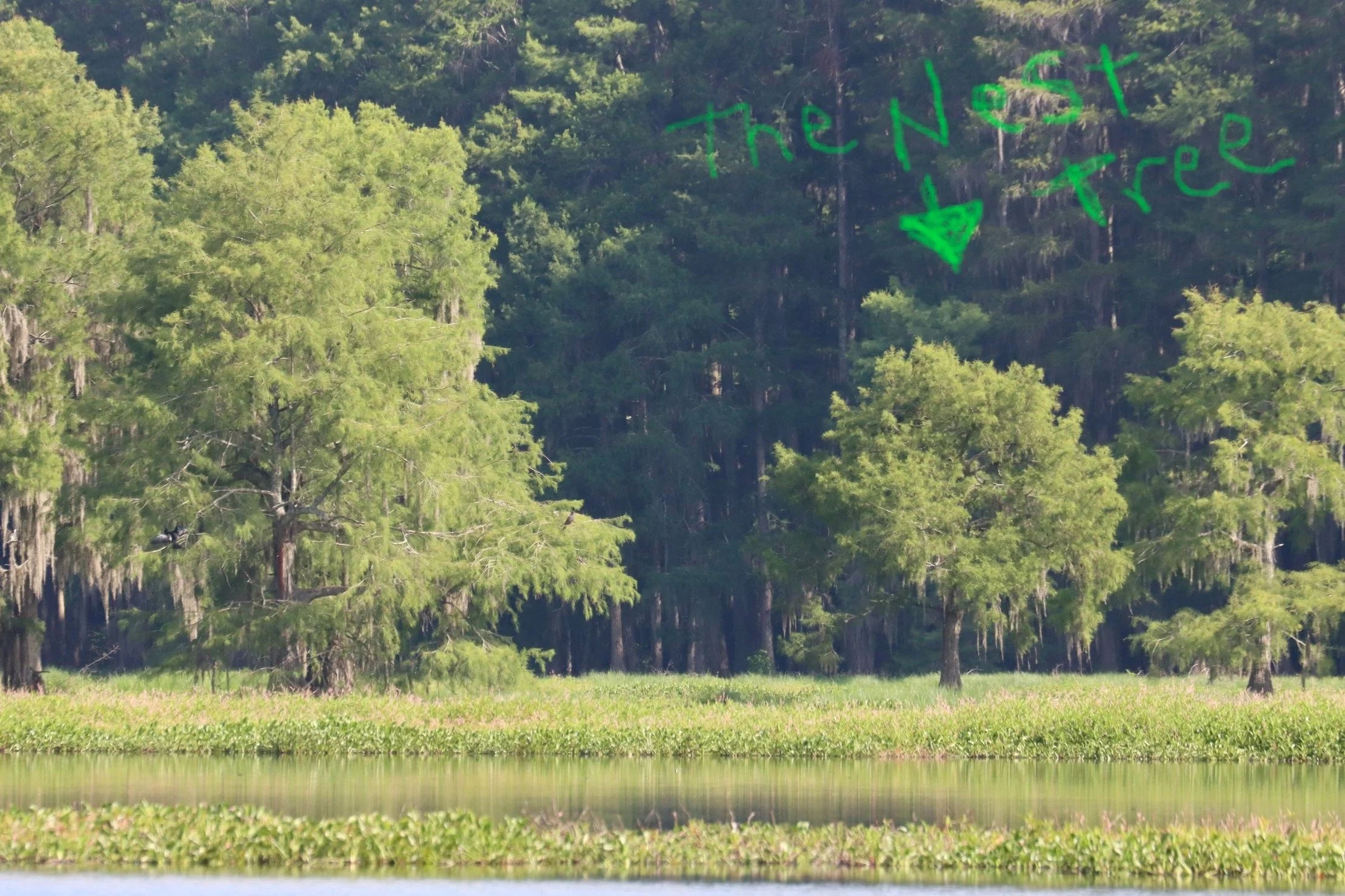
Arrow points to the small Pond Cypress where the nest was built.
The female was spending most of her time on the close side of the lake, but the nest and the male were on the far side of the lake. I found this odd and sometimes wondered, “How did the female make it to the other side of the lake without me seeing her go?” I began to suspect that there were three birds. On May 3rd, I FINALLY saw all three birds at the same time. More excitement! Three Snail Kites!
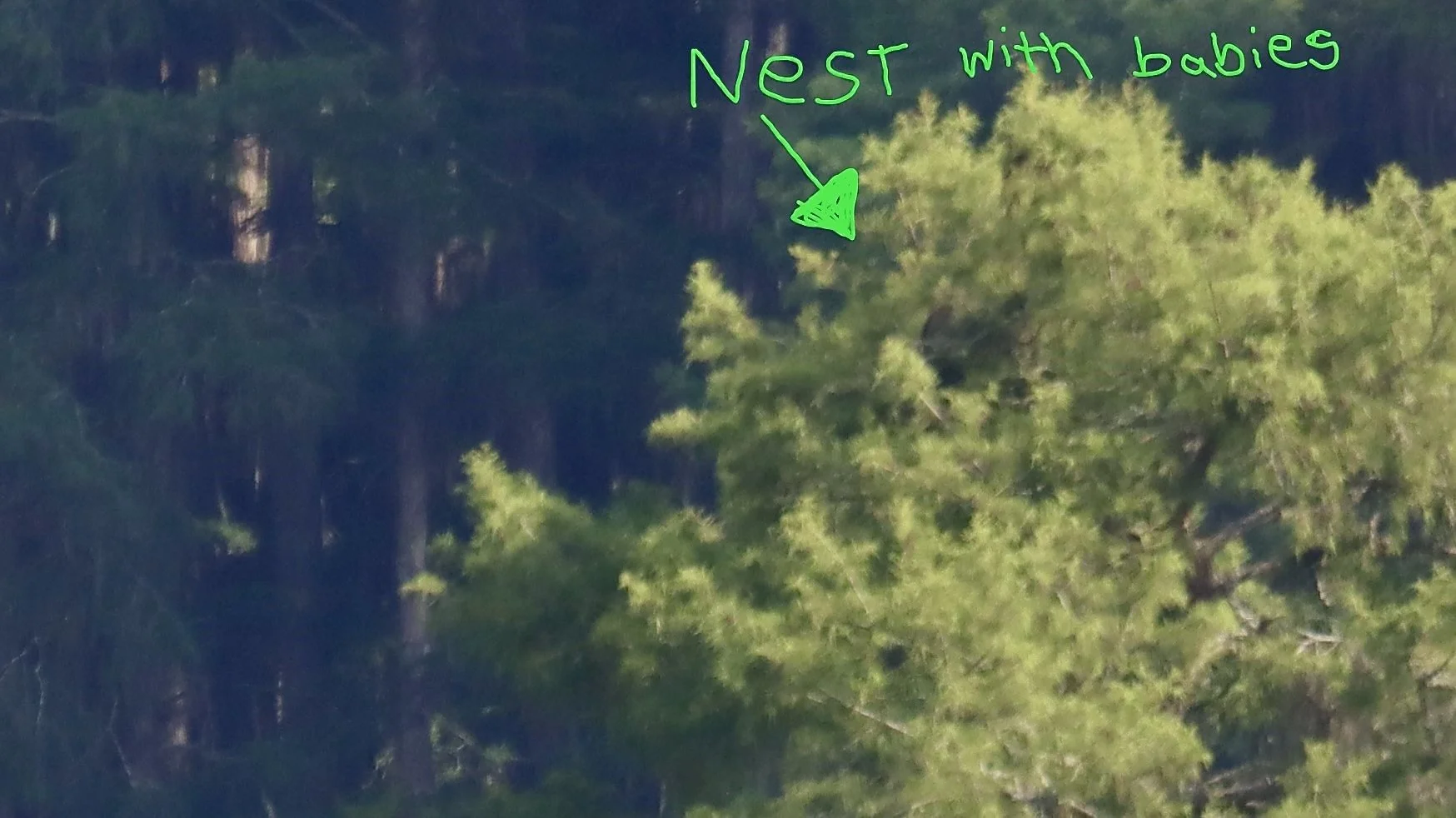
Arrow points to the area of the tree where the nest was located.
Three Chicks: With every new discovery I have been left feeling like an excited kid at Christmas. As my Snail Kite watch continued day after day, I shared the information and did everything I could to get documentation of all the events. A trip via boat in mid-May by biologists from the Florida Fish and Wildlife Conservation Commission (FWC) proved inconclusive, but on May 30th Lara Elmquist from the Snail Kite Project (University of Florida, UFL) in conjunction with FWC and came back with the good news that there were indeed three small chicks in the nest!
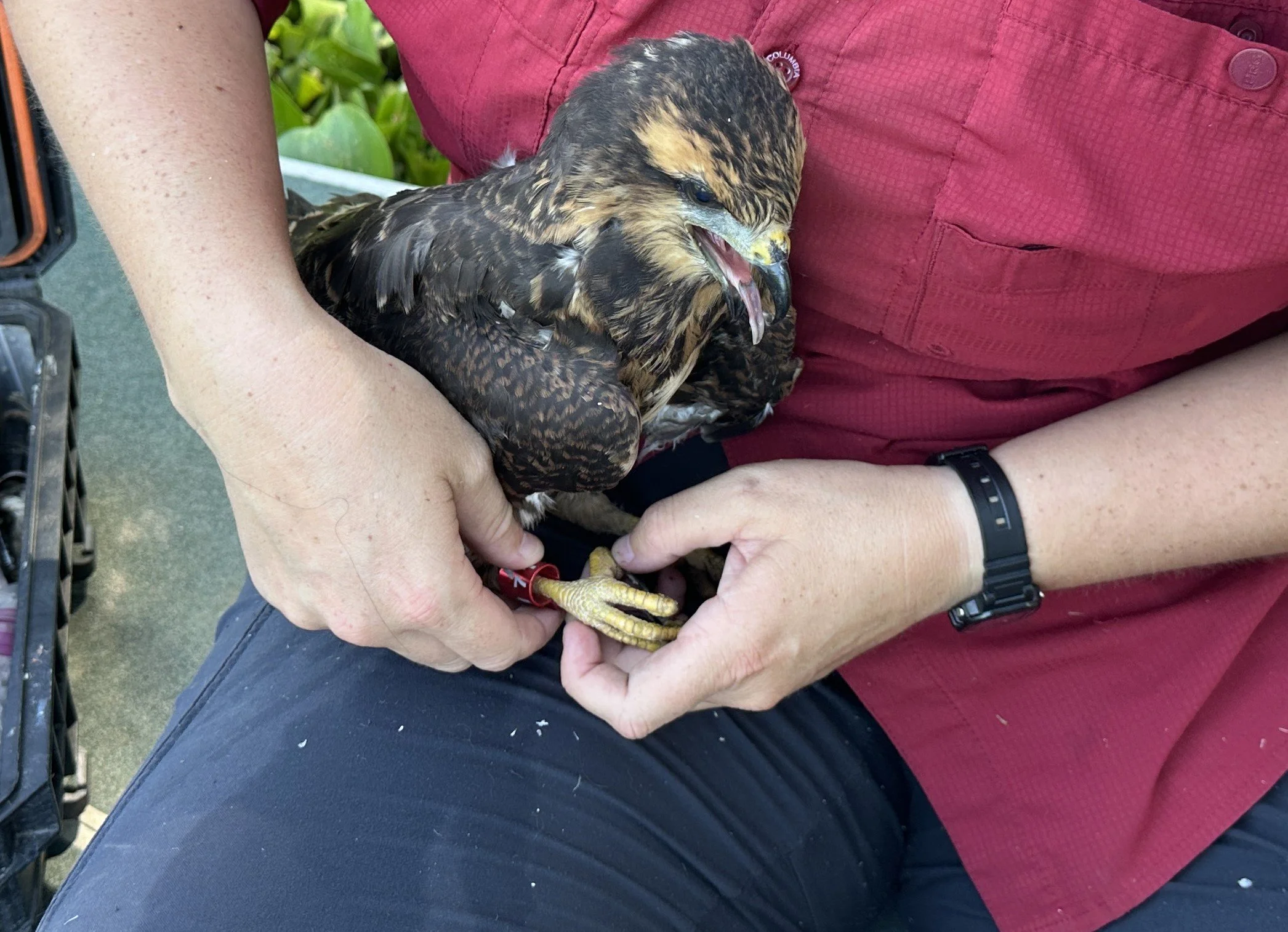
Young Snail Kite being banded by Lara Elmquist.
Banded: The furthest north where Snail Kites have been documented breeding is Gainesville, over 150 miles away. Laura indicated that they would need to come back in a few weeks to band them when they were bigger. That event happened on June 23rd. At that time, Lara Elmquist (UFL), Caroline Poli (FWC), Derek Fessell (FWC), and Michael Hill (retired from FWC) made the trip out and all three chicks were banded.
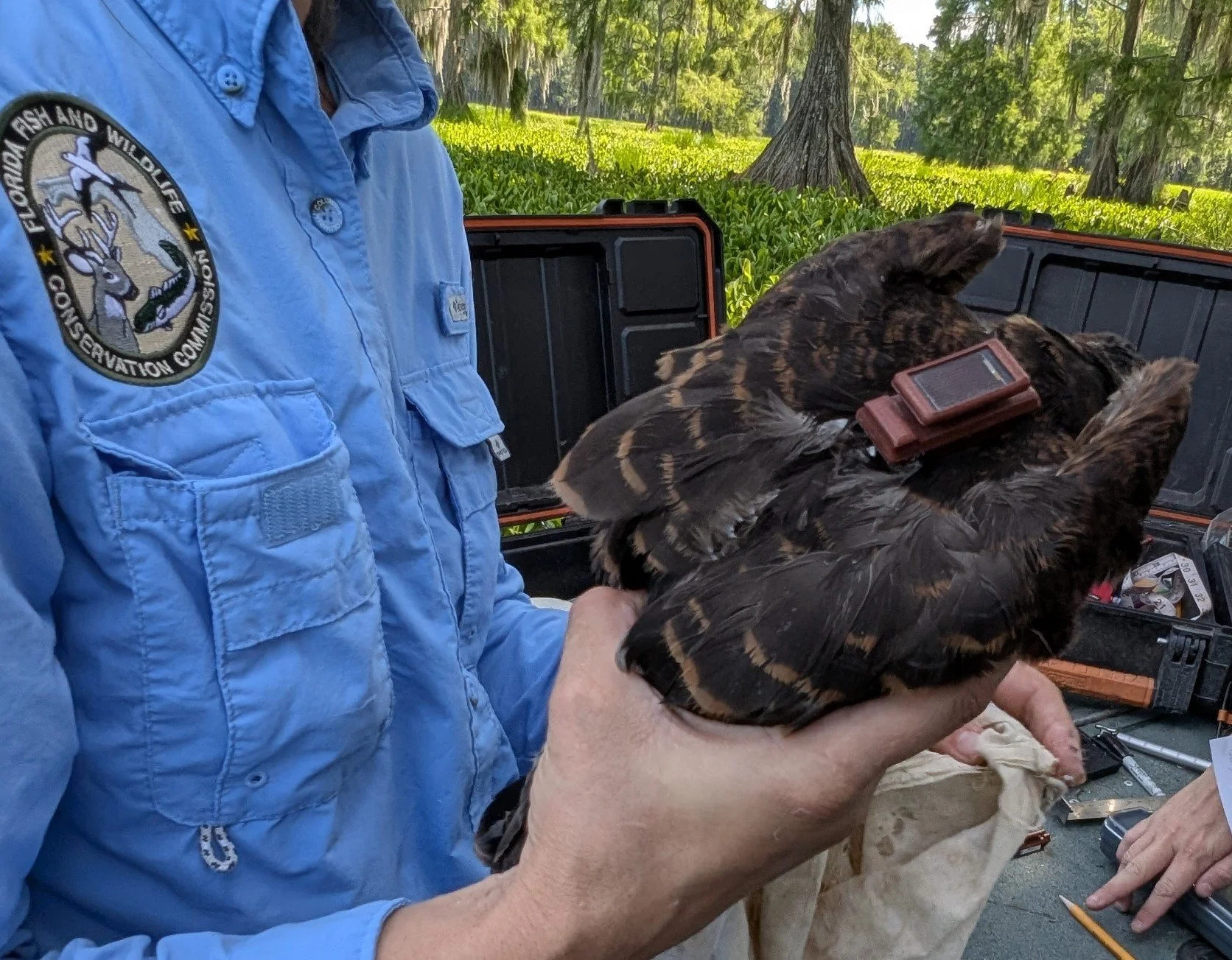
One of the two young Snail Kites that was outfitted with a solar-powered tracking beacon. Photo by Michael Hill.
Tracking Devices: Two of the young Snail Kites were also fitted with tracking devices, locator beacons that are solar-powered and use cellular phone technology. Each bird has it’s own phone number and can be located at any time. Snail Kites are a typically nomadic species. These tracking devices will show the young birds' movements and help provide information that can help with managing and protecting their habitats. The Snail Kite was listed in Florida as an endangered species in 1967, residing primarily in the Everglades. It was estimated that in the early 1940s there were as few as 50 to 100 Snail Kites. Thanks to various agencies and people working together to manage their habitat and protect them they have had many ups and downs but have an overall upward trajectory. In 2021 there was estimated to be 3,171 individuals. The University of Florida is in charge of the main monitoring of Snail Kites. They conduct a series of surveys starting in January to find nests, monitoring them and banding the young. They take that information and work with the USGS and FWC to manage their habitats and put protections in place so that they can continue to succeed. Now our Lake Munson Snail Kite young are banded and adding to that information with their tracking devices in place.
Nest #2: Work keeps me busy Monday, Tuesday, and Wednesday so I was not able to visit the birds on their banding day and the two days that followed. Thursday, June 26 finally rolled around and I headed to the lake as soon as I was able. At this time, I could see two of the young birds which were now moving around in the nest tree and making small flights in the tree but still not leaving it. The third young bird was nowhere to be seen. The female (mother) bird continued to bring food to the two remaining babies. The male bird was sitting in a spare nest he made in a tree nearby. He remained there the whole time I was there. The next day, Friday, June 27, I was unable to find any of the young birds. The female was visiting lots of her usual perches and feeding only herself that I could see. Meanwhile, the male remained hanging out in his spare nest.
The next day, Saturday June 28th, two of the young birds, now fledglings, were flying around and awkwardly landing in various spots in the vicinity of their nest tree. The male continued to sit on the spare nest. The female collected a snail and went to one of her favorite perches to shuck the snail from its shell. While she was doing this the male finally came off the spare nest and went and grabbed some new nesting material.
Nest #2 Surprise: Before he could return to the nest to add the new nesting material the female flew into the nest with her shucked snail in her beak. When she entered, I could see with my scope just barely in the nest as a tiny little head came up wobbling and bobbing reaching for the mother bird’s goodie, and then a second little bobbling head popped up! At the time this is being written, July 7, I have seen three fuzzy babies in the nest! As amazing as it seems, this pair worked together to care for their three fledglings as they prepared to move into a different stage of life, while also re-nesting and incubating this new batch.
As we battle to prevent the loss of the planet's biodiversity it is very easy to feel we are fighting a losing battle. This one is a story of hope and small successes that hopefully will continue to pave the way for more successes. So, I encourage you all to see hope, appreciate the success that have come with our system's help. So come to Lake Munson and let's go watch a flying Snail Kite!
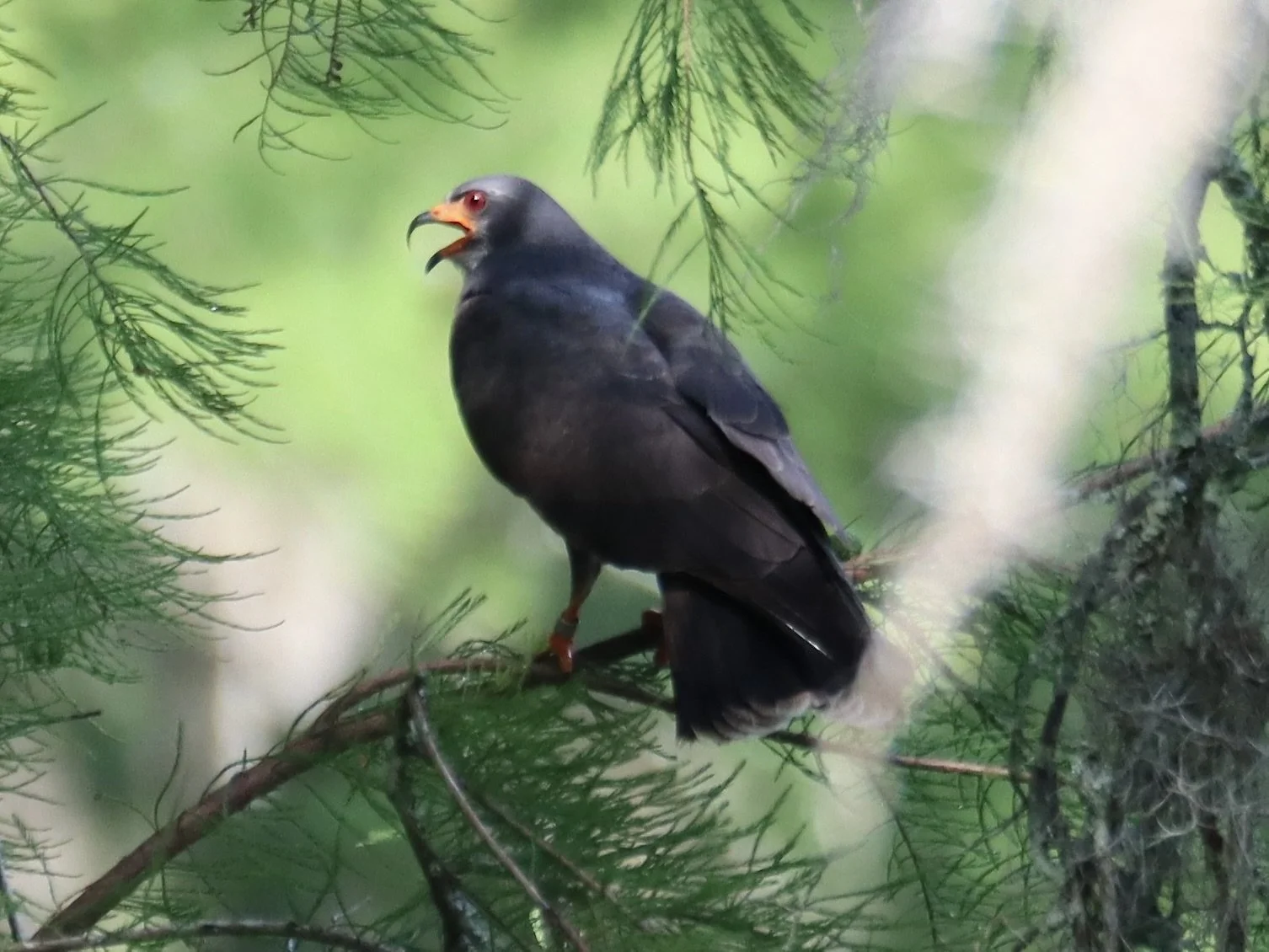
Snail Kite perched in a cypress tree at Lake Munson.
See more photos—and bird species—in the following eBird Checklists that Juli submitted from Lake Munson.
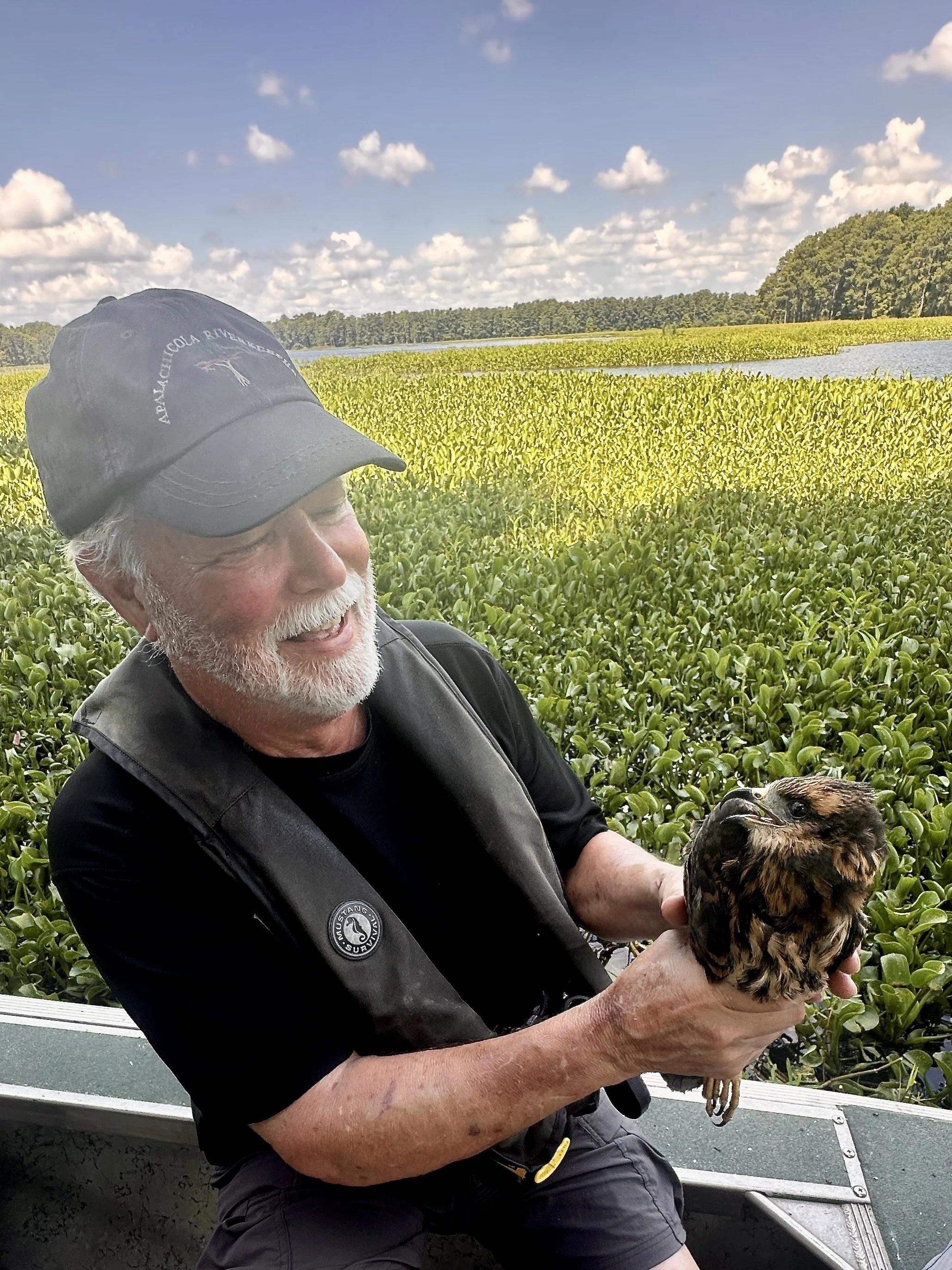
Michael Hill holding one of the young Kites
What an adventure I had June 23 on Leon County’s Lake Munson! Juli deGrummond, an intrepid birder who loves listening to Limpkins, was watching them nesting and eating the uncountable non-native, invasive Apple Snails. In April, she espied a couple of Snail Kites (SNKI) frolicking among the cypress trees and also enjoying the Apple Snail buffet. Before long, the SNKI nested and raised three young. This marks the first nesting SNKI in Leon County and the northernmost successful nesting effort. Previously, it was determined that the adult male had been banded and lived on Paynes Prairie. Not sure where the adult female came from.
On June 23, as a retired Fish & Wildlife Conservation Commission (FWC) Project Manager, I invited myself to ride along on the FWC airboat and assisted in banding the three young Kites. A team from Gainesville, Caroline Poli—a FWC ornithologist and Lara Elmquist—a University of Florida raptor and SNKI expert, came to band and install GPS locator beacons on two of the young. These two kites now have their own cellular phone number and can be tracked any time of day! Not satellite, not radio, but phone!
Enjoy the following photos that I took that day.

Caroline Poli (who trains at a rock climbing gym) scampered up the pond cypress tree and deftly lifted up two of the young Kites and handed them down to us. The oldest and heaviest bird flew a short distance and landed in the water hyacinths, where we netted it soon after.

The flying Kite safely in hand after Lara Elmquist gently netted it off the hyacinth mat.

Lara Elmquist holding a squawking fledgling. The adults were nearby, but never swooped at us. The young squealed until a hood was placed over its head, a common technique for calming birds.

Lara taking essential measurements after this Kite was banded.

Caroline attached the transmitter and solar panel, affixed by a harness. Once the bird preens itself, the feathers will neatly align just under the solar panel.

A freshly banded SNKI with tracking device installed. With that menacing hooked beak, I expected one of us to be bit! The young birds only squawked and never bit anyone.

The transmitter with parts of the harness.

A close up of the transmitter being mounted to the bird.

Time for putting the birds back in the nest. They tolerated being held and carried up the tree by Caroline. For a time, the young stayed in the nest or nearby branches until we left the lake.

Parachute cord treatment to reduce window strikes by birds.
Bird populations worldwide have declined by over 3 billion individuals since 1970, and one of the major contributors to this alarming decrease is bird-window collisions. This issue disproportionately affects migratory birds—those that travel seasonally from one region to another—making areas like Tallahassee, which lies at the intersection of major migratory flyways, especially vulnerable.
During migration, thousands of birds pass through Tallahassee at night, navigating through residential areas and encountering hazardous glass windows. These collisions not only harm birds but can also disrupt local ecosystems.
Two key measures can help reduce bird-window collisions:
Lights Out Initiatives: Migratory birds can be disoriented or blinded by bright lights at night. By turning off unnecessary lights or using dimmers, you can help reduce collisions.
Window Treatments: Making windows visible to birds through physical barriers or designs can prevent them from flying into glass. Options include:
UV or regular dot stickers
Zen curtains
Tempera paint designs
Fritted glass or window wraps
The Spoonbill Society, FSU’s student birding organization, in collaboration with the Apalachee Audubon Society, is actively working to reduce bird-window collisions across Tallahassee. We’ve been surveying bird-window strikes on the FSU campus and speaking with administration to explore potential solutions. Now, we’re hoping to expand our efforts to residential areas in Tallahassee.
As part of this initiative, we will be creating educational videos that will be posted on the Apalachee Audubon website and YouTube channel. These videos will help residents understand the importance of preventing bird-window collisions and how they can implement effective measures at home.
We’re looking for individuals who have already implemented bird-window collision prevention measures in their homes or buildings. If you’ve used window treatments or participated in Lights Out initiatives, we’d love to hear about your experience.
If you’re interested in sharing your treatments and advice while having it featured in our upcoming videos, please reach out to us at:
Email: jew22@fsu.edu
Phone: 786-999-4365
Any advice or comments are also welcome!