Most birders rely on auditory cues to help locate and identify species. As the popularity of apps like Merlin has skyrocketed, more and more people are using bird calls to assist with identification. While some birders possess finely tuned ears and feel confident to add a bird to their list based on audio alone, for myself, calls are a crucial piece of a larger picture. Bird identification is very much like putting together a puzzle, as you gather clues, the picture becomes clearer and clearer until it comes together and is complete. For many cryptic species, distinguishing the call is either helpful or absolutely essential for an accurate identification.
Merlin is an invaluable tool for solving these puzzles, and the recordings you gather can contribute high-quality data to the scientific community via eBird. However, to get the most accurate results from sound identification software, you need to capture the cleanest audio possible.
When using Merlin, your primary goal should be to isolate the sound of your target bird. If you can safely move closer without disturbing or disrupting the bird, carefully reduce the distance before you start recording. If you are documenting a rare bird or significant call, keep recording as you approach so you don't miss the moment. Once you reach a closer vantage point, stop and save that initial track, then start a fresh recording to capture the higher-quality audio.
Whenever possible, try to minimize background noise like wind, footsteps, or traffic. Of course, a perfect environment isn't always achievable in nature; at the end of the day, a noisy recording is still much better than no recording at all. If the bird is singing consistently, aim for a track length between 30 seconds and two minutes. If your final recording ends up being much longer, or contains prominent noise and competing bird songs, you can use basic audio editing software later to trim and clean up your files before uploading them. By taking these mindful steps in the field, you will improve your own identification accuracy and ensure your contributions to citizen science remain highly valuable.
Adding these sound recordings take your reporting to the next level but I also want to encourage birders to verify what they are hearing and not just take Merlin's determination as the correct diagnosis. I will share with you some experiences I have had where if I had just reported what I heard or what Merlin was telling me I was hearing, I would have made an incorrect reporting.
One time I was at Jonathan Dickinson State Park in south Florida. I was driving slowly, windows down scanning for Florida Scrub Jays. Suddenly the very familiar, melodic sound of a Bachman's Sparrow singing carried across the very area I was searching! I hit the brakes and scanned and scanned looking for the bird. It had sounded so close, yet now had gone silent. I scanned and scanned without any luck spotting it. Even though I am very familiar with this bird, and know it's song when I hear it, I like to confirm what I hear visually and if possible get a recording to add to the data. After a minute it sang again and I scanned and scanned without luck. I decided that I would go ahead and add it to my list, after all I was confident that the song I heard was that of a Bachman's Sparrow, and want to include all the birds present that I can identify for science's sake if nothing else. Right after I added it but before I drove away a girl popped out the bushes holding a parabolic microphone. It became instantly obvious to me that she had been playing the call and that it was her playback that I heard. I laughed to myself and shook my head at the humor of it all. Naturally I took it off my list and carried on with my birding. I have reflected on this experience quite a bit since, I realize I could have easily not seen that person and left it on my list. I would have been none the wiser and would have inadvertently added an inaccurate report. Obviously this is not likely to be a frequent occurrence but it is an indicator of things that can mislead you and Merlin. There are some birders out there that rely on playback as a regular part of their methods for finding or getting to see birds, so it stands to reason that if you are in a location where there are other birders, potentially this could be the case.
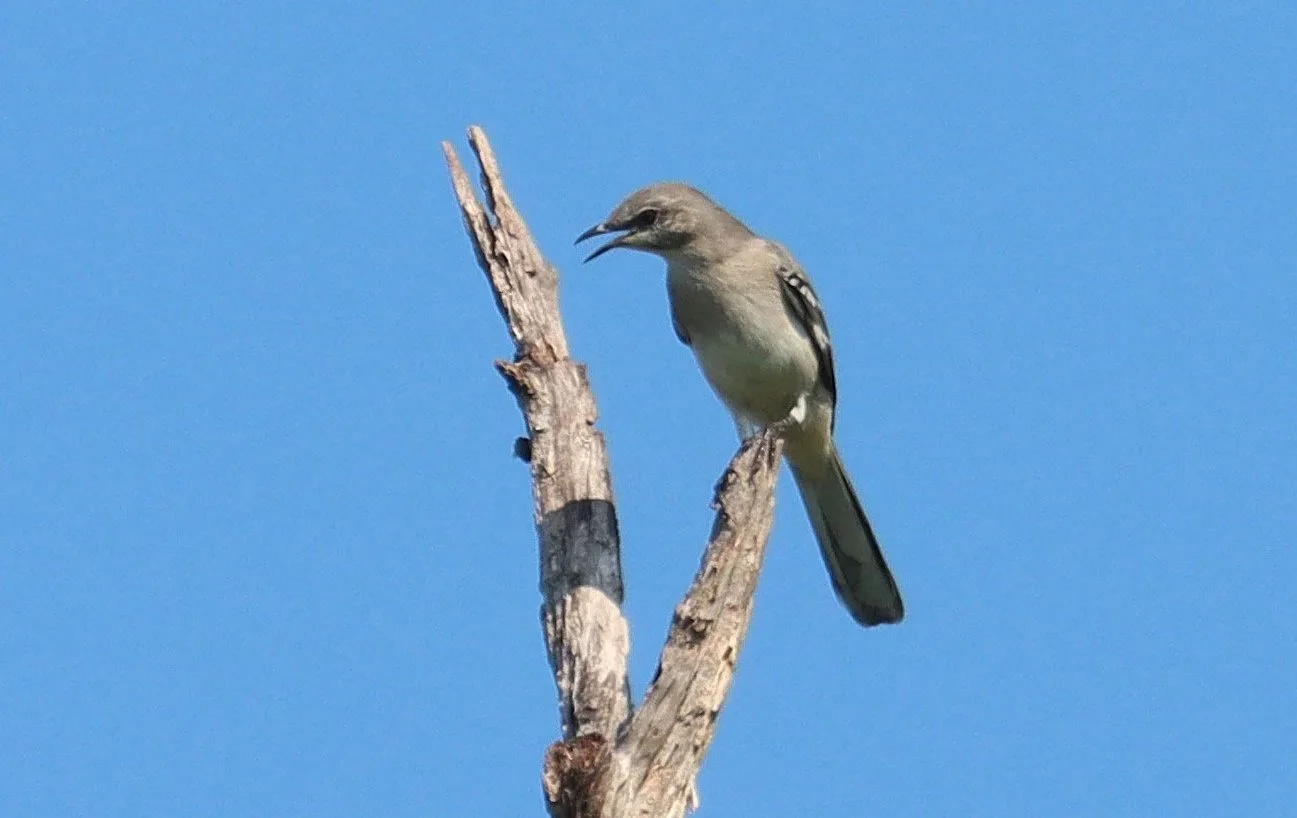
Northern Mockingbird, by Juli deGrummond
Another situation that does come up more frequently than this kind of scenario is one involving birds that are mimics. Northern Mockingbird is one of the most frequent culprits in the United States, when it comes to mimicry. I have seen and heard Northern Mockingbird imitate so many different birds really well. Northern Mockingbirds have been documented imitating over 200 different birds call. Some that I have personally heard are Bald Eagle, Killdeer, Mississippi Kite, Red-bellied Woodpecker, Carolina Wren, Black Rail, Common Nighthawk, and Tropical Kingbird, just to name a few!
Not only do these imitations sound accurate but Merlin also believes they are the imitated bird. It can be quite fun to run Merlin and watch it while listening to a singing Mocker. When you watch live and see what results come up the "heard" bird will light up letting you know that is what you are hearing. Northern Mockingbirds are not the only tricksters by a long shot. Brown Thrashers and Gray Catbirds are also very talented mimics. Most of us have probably heard a Blue Jay imitate a Red-shouldered Hawk or a Red-tailed Hawk whether we realized it or not. Blue Jays can be stunningly accurate or humorously inept and everywhere in between.
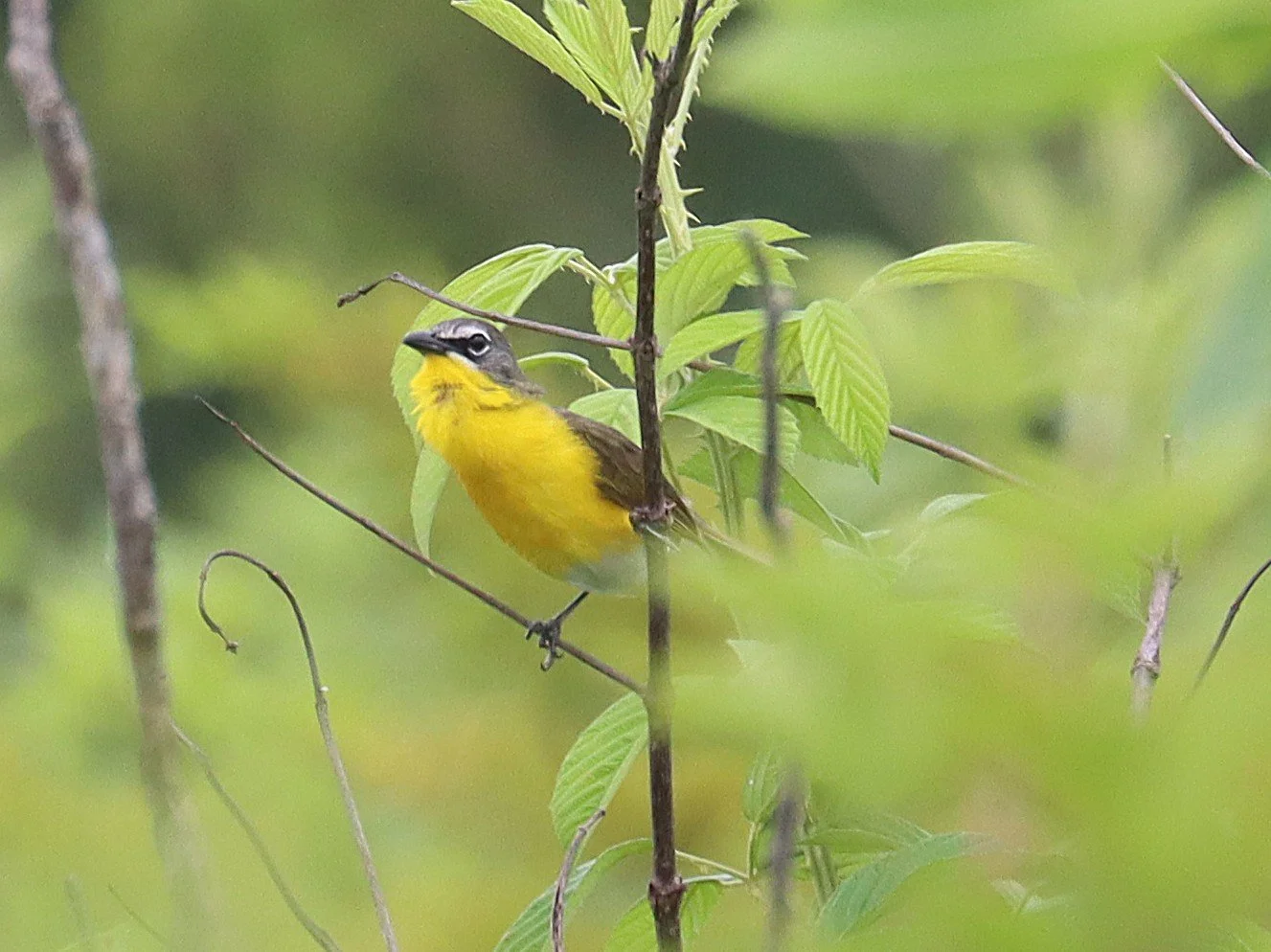
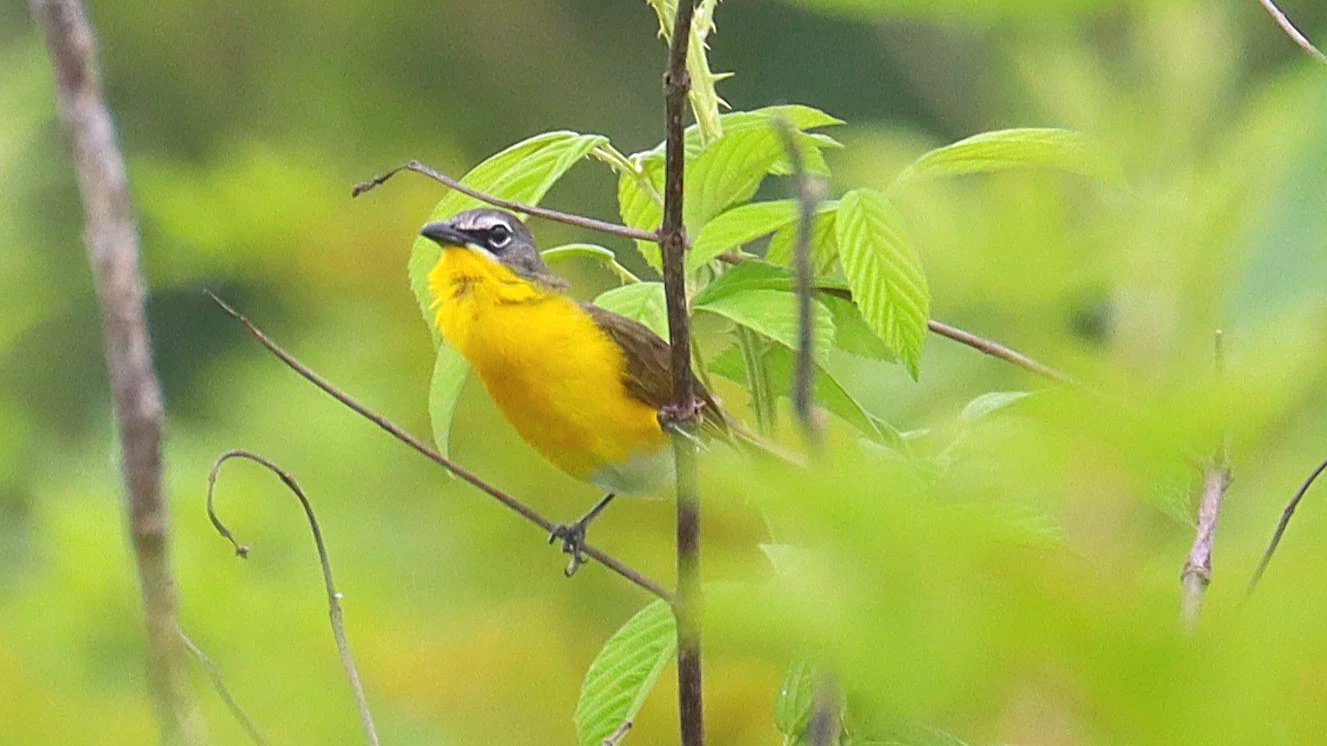
Yellow-breasted Chat, by Juli deGrummond
Recently I heard a White-eyed Vireo imitate a White-breasted Nuthatch over and over again. It was very accurate sounding, and Merlin again and again picked it up as White-breasted Nuthatch. I believed it to be a White-breasted Nuthatch. I followed the sound in order to get eyes on it. Imagine my surprise when the call lead me right to a White-eyed Vireo instead. I observed and recorded the bird making this call repeatedly. Not long after this, I experienced yet another bird, a Yellow-breasted Chat, also imitating a White-breasted Nuthatch over and over again. Once again, Merlin also believed it to be a White-breasted Nuthatch. I found this intriguing. As I listened and watched these birds I came to the conclusion, a White-breasted Nuthatch must have a fun call to sing.
Checklist for Faulk Dr., Yellow-breasted Chat mimic
Checklist for Letchworth Mounds, White-eyed Vireo mimic
With the meteoric rise of apps like Merlin Bird ID, sound identification has become a more accessible piece of the puzzle. Merlin is an absolute gift for solving these mystery calls and identifying birds that the call is critical to proper ID. The tracks we save contribute vital data to the scientific community via eBird and add an enjoyable flourish to our own eBird lists. It also is a fantastic learning tool for birders new and old. In order to get the most out of this incredible tool and to keep citizen science data clean, we have to be mindful about how we record. I encourage you to embrace these fantastic new tools but make sure you do not leave out the personal element and enjoyment that you get from verifying what you hear. Reporting based on Merlin alone is a trap that keeps eBird reviewers very busy. That is the beautiful, messy reality of modern birding. Let this technology open a door for you, then let your wonder and curiosity guide you through it and to the birds.
Happy birding!